Singh also said that India will give a befitting reply to anyone threatening its unity, sovereignty and territorial integrity as it no longer remained a "weak" country.

He said both sides reaffirmed to sincerely work towards complete disengagement of the troops along the LAC.

For the first time, the Chinese military on Thursday acknowledged last year's incursion at the DepsangValley in Ladakh region and said such incidents occurred due to different perception about the Line of Actual Control.
India and China should be able to achieve status quo in eastern Ladakh in a gradual manner as both sides understand that it is in the best interest of ensuring peace and tranquillity in the region, Chief of Defence Staff General Bipin Rawat said.

His comments came in the midst of India's bitter border row with China along the LAC in eastern Ladakh.

In its annual threat assessment presented before the Senate Armed Services Committee during a Congressional hearing on Tuesday, the US intelligence community said the expanded military posture by both India and China along the disputed border elevates the risk of armed confrontation between the two nuclear powers that might involve direct threats to US persons and interests and calls for America's intervention.
Pompeo explains how the Donald Trump administration succeeded in bringing India on board the Quad grouping.

"After the Major General-level talks on Wednesday, the talks are expected to be held over the next few days in Chushul at multiple levels to find solutions to the dispute in specific areas," sources said.
'Gorkhas are terrific soldiers. They are known the world over for their fighting qualities.'

Congress spokesperson Supriya Shrinate also alleged that foreign policy has been reduced to photo-ops and a chest-thumping exercise and is being used to secure contracts for a businessman.
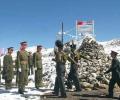
The two armies had mutually decided not to resort to use firearms during face-offs in sync with provisions of two agreements on border management.
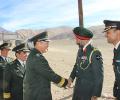
Amidst reports of Chinese incursions, the Peoples Liberation Army and the Indian Army on Sunday decided to uphold treaties and agreements signed between the governments of the two sides to maintain peace and tranquility along the Line of Actual Control.
At an online media briefing, External Affairs Ministry Spokesperson Anurag Srivastava gave a run down of the events along the LAC in the eastern Ladakh region and held China responsible for the Galwan Valley clashes off June 15.

Prime Minister Modi and President Xi held the conversation on Wednesday on the sidelines of the BRICS (Brazil, Russia, India, China, South Africa) summit in Johannesburg.

"They are likely to intimate date and time soon. Delay attributed to bad weather conditions on their side," Rijiju wrote on Twitter.

Gen Rawat carried out an aerial recce of certain areas and was briefed about key aspects of the security matrix in the region by senior military commanders.
Since China began this buildup, the Indian side says Chinese troops will have to start the de-escalation. Only then will Indian troops go back. The June 6 meeting agreed to this roadmap.

As part of the mega plan, around 20 bridges, a number of tunnels, airbases and several key roads are being developed in strategically key areas in Arunachal Pradesh to bolster the overall military preparedness, officials said on Monday.
A defence ministry public relation officer from Tezpur on Sunday said the Chinese army has communicated to India that they have found a missing boy from Arunachal Pradesh.

They said various Mandarin language courses are being run at the language schools at the Northern, Eastern and Central commands of the Army.
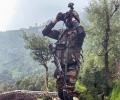
Pakistan may want to undertake a 'false flag' operation in J&K to divert attention from the situation in Balochistan and Khyber Pakhtunkhwa but infiltrating one SSG battalion into J&K and having two SSG battalions waiting to follow suit means war, which Pakistan cannot afford in its current economic crisis, notes Lieutenant General Prakash Katoch (retd).

The teenager, identified as Miram Taron, was abducted by the PLA from Lungta Jor area under Siyungla area on Tuesday.

In an interaction with the commanders at their ongoing biannual conference, Singh reasserted the faith of the billion-plus citizens in the Indian Army as one of the "most trusted and inspiring organisations" in the country.
The Indian delegation led by Lt General Harinder Singh, the general officer commanding of Leh-based 14 Corps, and Commander of the Tibet Military District Maj Gen Liu Lin held an extensive meeting in Maldo on the Chinese side of the Line of Actual Control in eastern Ladakh on Saturday that began at around 11.30 am and went on till evening.

Defence Minister Rajnath Singh on Tuesday handed over to the Army a raft of home-grown military hardware including unmanned aerial systems, quick reaction fighting vehicles, patrol boats and surveillance equipment for boosting its overall combat capability in eastern Ladakh.

India said it is strongly committed to ensuring its sovereignty and territorial integrity.

After their troops remained in "face-to-face" situation for nearly three weeks, India and China have agreed to restore status quo along Line of Actual Control in Western Sector as it existed prior to April 15, when Chinese intruded into Indian territory there.

China on Thursday declined to give any timeline for withdrawal of its troops from Depsang valley in Ladakh but said the issue that has sparked new tensions in bilateral ties "will be properly resolved soon through negotiations".
Prime Minister Manmohan Singh and Chinese Premier Li Keqiang signed the border agreement to ensure that both countries do not tail each other's military teams along the LAC. Sheela Bhatt reports from Beijing

India raised the issue with China last week immediately after the incident of Chinese incursion came to light.
Chinese may adopt similar tactics to test the nerves of the Indian establishment, reports RS Chauhan
The document, which was uploaded on the defence ministry's website, was removed on Thursday morning following publication of a media report based on it.

From Eastern Ladakh to Sikkim, new drone units that can carry out missions for up to 48 hours are begin deployed.

Every week, we bring you fascinating videos, chosen by you, through your likes.

In his farewell remarks posted on the Chinese embassy website, Sun said it is only natural for important neighbours China and India to have some differences but the key is how to handle the differences.

'Our villagers used to go up to Finger 4 and Finger 6, but today the Chinese are there.' 'Since April 2020, Chinese troops have blocked Indian troops from reaching at least ten patrolling points running from the Depsang plains in the north to Pangong Tso lake in the south.'

Viewed from the Indian side, China's infrastructure building along the LAC is a serious threat.

The papers presented by Indian Police Service officers at the just concluded conference of director generals of police (DGPs) and inspector generals of police (IGPs) submit that by providing huge amounts of money in the name of loans for developmental works in Southeast and South Asia, China wants to reduce India's influence in the Indian Ocean region and force resolution of bilateral issues on Beijing's terms.
Some may see China's decision to antagonise India as strategically unwise. But China believes its prestige demands standing up to India, whatever the cost.
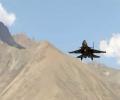
The Indian Air Force will carry out a mega exercise covering the Northeastern region early next month to check its combat readiness, amid a fresh spike in tension with China along the Line of Actual Control in Arunachal Pradesh.
